The Complete HVAC Maintenance Guide for South Orange County Homeowners
If you own a home in South Orange County and your HVAC system has never been professionally serviced — or hasn't been serviced in more than two years — you are statistically more likely to experience a breakdown during peak summer heat than a homeowner who maintains their system annually. That's not a scare tactic. It's a consistent pattern we see every summer throughout Mission Viejo, Rancho Santa Margarita, Coto de Caza, and every other community we serve.
This guide covers everything you need to know about HVAC maintenance in Southern California — what needs to be done, how often, who should do it, and what it costs. It's specific to this climate and this region, because generic HVAC maintenance advice doesn't account for the realities of South Orange County's inland heat, coastal salt air, and Santa Ana wind seasons.
Why HVAC Maintenance Matters More in Southern California
Most of the United States treats air conditioning as a seasonal appliance — something that runs hard for three or four summer months and then gets a rest. South Orange County homeowners in inland communities like Mission Viejo, Ladera Ranch, and Coto de Caza run their AC systems for five to six months. Those same systems also provide heating in winter. Year-round use means faster wear, more frequent filter changes, and more accumulated dust and debris than manufacturers' standard maintenance intervals anticipate.
Additionally, Southern California's specific environmental conditions create maintenance demands that don't apply in other parts of the country:
Santa Ana wind events deposit significant quantities of dust, pollen, ash, and debris on outdoor condenser units. A single serious wind event can coat condenser coil fins with enough material to meaningfully reduce efficiency — which is why post-event condenser cleaning is worth doing.
Coastal salt air — relevant for homeowners in Dana Point, San Clemente, and Laguna Niguel — accelerates corrosion on aluminum coil fins, copper refrigerant lines, and electrical connections. Coastal homes need more frequent coil inspection and may benefit from corrosion-resistant coil coatings.
Wildfire smoke from regional fire events can overload standard air filters quickly and introduce fine particulates into ductwork and HVAC components. After a significant fire event in the region, replacing your air filter even if it's not due is worth doing.
Hard water affects condensate drain lines differently than soft-water regions — mineral deposits can build up in drain pans and lines over time, contributing to blockages.
The Annual Maintenance Calendar
Spring (March–May): AC Preparation — the Most Important Maintenance Window
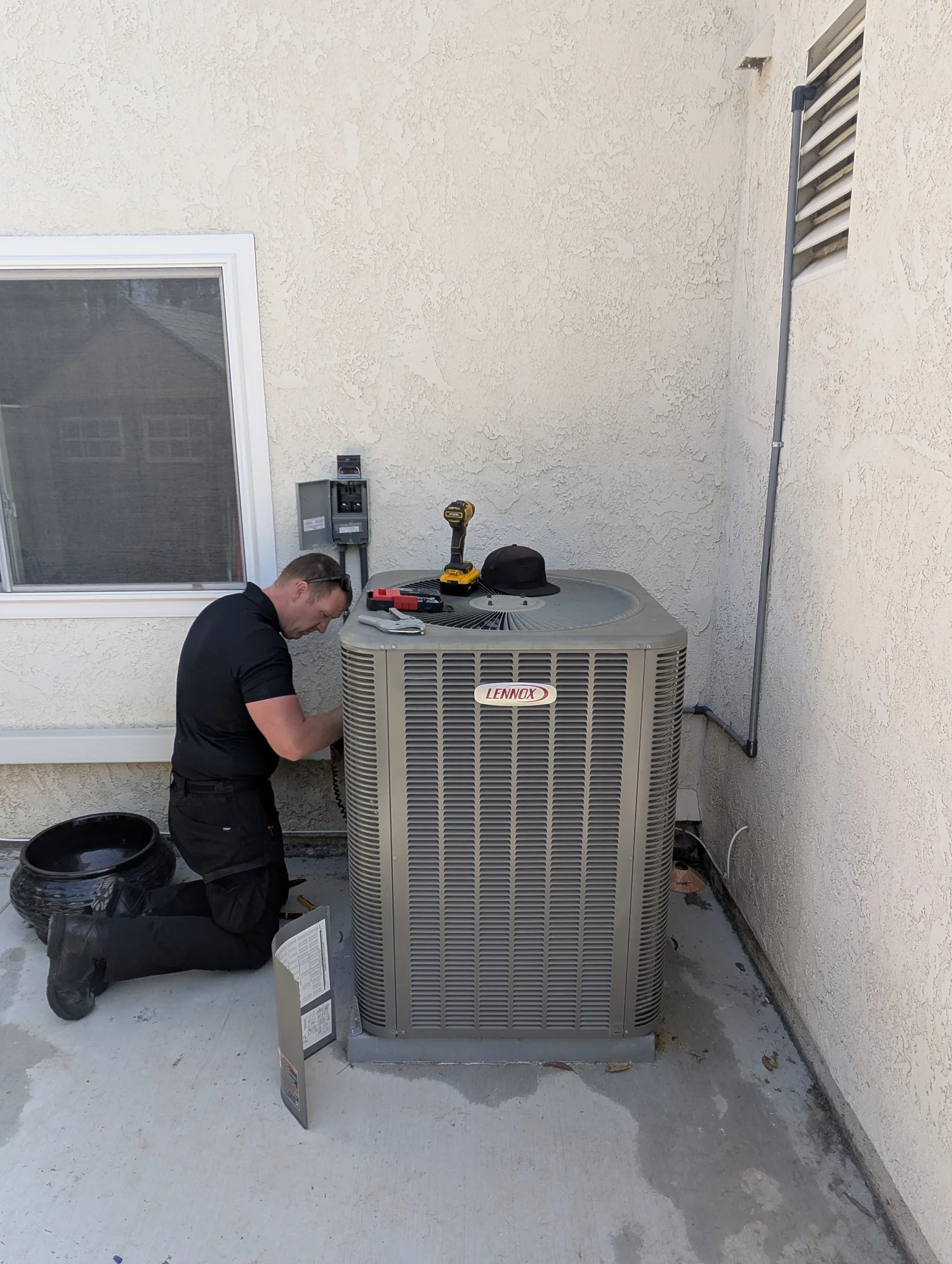
Spring is the critical maintenance window for South Orange County homeowners. Scheduling professional AC maintenance in March, April, or early May means you're getting service while technician availability is good, parts are in stock, and any issues found can be addressed without urgency pricing. Once June arrives and temperatures climb, every HVAC company in the region is responding to emergency calls and scheduling extends significantly.
What should be done professionally in spring:
Air filter replacement. If you haven't changed your filter since fall, do it now — or have your technician do it during the service visit.
Condenser coil cleaning. The outdoor unit has been accumulating debris all winter. A thorough cleaning of the coil fins — rinsing from the inside out — restores heat transfer efficiency and reduces compressor stress.
Capacitor testing. The capacitor's actual capacitance is measured against its rated value. Capacitors operating below 85% of rated capacity are failing and should be replaced before they fail during peak summer use.
Refrigerant pressure verification. System pressures are measured at the current ambient temperature and compared against manufacturer specifications. This tells the technician whether refrigerant charge is correct without opening the system unnecessarily.
Electrical inspection. All terminals, contactors, and visible wiring are inspected for corrosion, loose connections, and signs of heat damage.
Condensate drain flush. The drain line is cleared and the float switch is verified to be operational.
Blower motor inspection. The motor amp draw is checked against nameplate specifications — a motor drawing high amperage is working too hard and approaching failure.
Thermostat calibration check. The thermostat's temperature reading is verified and the communication between the thermostat and system is confirmed.
What you can do yourself in spring:
Walk around the outdoor condenser unit and clear any debris that has accumulated — leaves, dirt, plant material — from around the unit. Maintain 18 inches of clearance on all sides.
Check that the condensate drain line exit point (usually on an exterior wall or in a utility area) is clear and not obstructed.
Inspect visible ductwork in the attic or garage for disconnected sections, damage, or obvious leaks.
Replace the air filter. Set a calendar reminder to check it again in June.
Summer (June–September): Active Monitoring Season
Once summer arrives, shift from preparation to monitoring. You're watching for early warning signs that something is wrong.
Signs to watch for:
The system runs longer cycles than it did last summer to reach the set temperature. This is often the earliest sign of a developing problem — reduced refrigerant, dirty coils, or a marginal capacitor beginning to fail.
Unusual sounds from the outdoor unit or air handler. Rattling, grinding, or intermittent clicking that wasn't there before indicate mechanical wear.
Higher utility bills than the same period last year, without a change in usage patterns. Efficiency loss from any cause — dirty coils, refrigerant loss, duct leakage — shows up on your electricity bill before it becomes a noticeable comfort problem.
Ice or frost on refrigerant lines or the outdoor unit. This indicates either very low refrigerant or severely restricted airflow — both require immediate service.
Water in or around the air handler. Standing water in the drain pan means the condensate drain is blocked.
Summer DIY tasks:
Check the air filter monthly during peak cooling season. Mission Viejo's summer dust loads mean a filter that looks fine in May can be significantly loaded by July.
Keep the outdoor condenser unit clear of plant growth. Fast-growing summer vegetation can encroach on the unit, restricting airflow.
Rinse the condenser unit with a garden hose after significant wind events. A gentle rinse — not a pressure washer — removes salt and dust deposits before they initiate corrosion.
Fall (October–November): Heating Preparation
As temperatures drop, the system transitions to heating mode. This is the time to address heating system maintenance before the first cold nights of the season.
What should be done professionally in fall (or included in a combined annual service):
Furnace heat exchanger inspection. A cracked heat exchanger can allow combustion gases — including carbon monoxide — to enter the air stream. This is the most safety-critical inspection in residential HVAC.
Burner cleaning and combustion analysis. Burners are inspected and cleaned, and combustion efficiency is measured.
Igniter inspection. Hot surface igniters have a limited service life and often fail in early winter when first called upon after months of dormancy.
Flue and venting inspection. The flue is checked for obstructions, corrosion, and proper draft.
Heat pump inspection (for heat pump systems). Both heating and cooling mode operation are verified.
Fall DIY tasks:
Test your heating system before the first cold night. Turn the thermostat to heat, set it above current room temperature, and verify the system produces warm air within a few minutes. Discovering a problem in October is vastly preferable to discovering it on a 35°F night in December.
Check and replace the air filter. A clean filter matters as much for heating as cooling.
Test smoke and carbon monoxide detectors, and replace batteries.
Winter (December–February): Light Monitoring Season
South Orange County winters are mild, but heating systems are in use and deserve the same monitoring attention you give the AC in summer.
Watch for:
Unusually long heating cycles or a system that runs constantly without reaching set temperature.
Any unusual odors when the system first starts — a burning smell at the very beginning of the heating season is often accumulated dust burning off harmlessly, but a persistent gas smell requires immediate action.
DIY Maintenance Tasks: What Homeowners Can Do
Air Filter Replacement: The Single Most Important DIY Task
An air filter that's overloaded with dust and debris restricts airflow through your HVAC system. Restricted airflow stresses the blower motor, can cause the evaporator coil to freeze, reduces cooling and heating capacity, and makes everything downstream — every other component in the system — work harder.
In South Orange County, replace your filter every 60 days during cooling and heating seasons. Homes with pets, allergy sufferers, or near construction may need monthly replacement.
Filter selection matters. MERV ratings range from 1 to 16 for residential filters. A MERV 8 filter is appropriate for most systems and captures dust, pollen, pet dander, and mold spores effectively. MERV 11 to 13 filters capture finer particles — good for allergy sufferers — but restrict airflow more and should only be used if your system has adequate fan capacity. MERV 16 (HEPA-equivalent) filters are too restrictive for most residential HVAC systems without modification.
Use the filter size printed on your existing filter's frame. Correct sizing matters — an undersized filter leaves gaps around the edges that allow unfiltered air to bypass the filter entirely.
Condenser Unit Clearance
Keep 18 inches of clearance around all sides of your outdoor condenser unit. Trim back any vegetation that grows into that clearance zone. Restricted airflow around the condenser unit forces the system to work harder to reject heat — particularly problematic on Mission Viejo's hottest days when ambient temperatures are already working against the system.
Thermostat Batteries
Most programmable and smart thermostats use batteries. Replace them annually — a thermostat that loses power and resets to default settings during a heat wave is a minor but avoidable inconvenience.
Condensate Drain Maintenance
Once a year, pour a cup of diluted white vinegar down the condensate drain line access port (usually a PVC pipe near the air handler with a cap). This discourages algae growth without the chemical residue that bleach can leave. Some homeowners do this every spring as a simple preventive step.
Vent and Register Inspection
Walk through your home and verify that all supply and return vents are open and unobstructed. Furniture, rugs, and curtains placed over registers restrict airflow and create pressure imbalances in the duct system. Every closed or blocked register increases static pressure in the duct system and stresses the blower motor.
Professional Maintenance: What to Expect and What to Pay
A professional annual HVAC tune-up in South Orange County typically costs $125 to $275 depending on system type (single-zone vs. multi-zone), location, and what the service includes. Be cautious of deeply discounted tune-ups advertised at $49 or $79 — at those price points, the visit typically involves minimal actual inspection and may be structured primarily to identify upsell opportunities rather than provide genuine maintenance value.
What distinguishes a quality tune-up from a cursory visit is time and thoroughness. A proper inspection of a standard single-zone system takes 45 to 75 minutes. A technician who completes the visit in 20 minutes didn't do a thorough job.
Maintenance Plans: Worth It?
Annual maintenance plans — where you pay a flat annual fee in exchange for scheduled tune-ups and sometimes discounts on repairs — can be worthwhile for homeowners who would otherwise defer maintenance. The value depends on what's included.
A good maintenance plan includes at minimum: one annual tune-up, priority scheduling for service calls, and a discount on parts and labor for any repairs needed during the plan period. Plans that include multiple annual visits (spring AC and fall heating) provide more value than single-visit plans.
Maintenance for Specific System Types
Heat Pump Maintenance
Heat pumps require the same maintenance tasks as conventional split systems, but with two additional focus areas. First, both heating and cooling mode operation should be verified during each service — a heat pump with a failing reversing valve may cool adequately but heat poorly, and the problem may not be noticed until the first cold night. Second, outdoor unit defrost cycles should be verified to be functioning correctly — a heat pump that doesn't defrost properly in cold weather will develop ice buildup on the outdoor coil and lose heating capacity progressively.
Ductless Mini-Split Maintenance
Mini-split systems have washable filters in each indoor air handler that should be cleaned monthly during use. Remove the filter, wash it with mild soap and water, allow it to dry fully, and reinstall. The outdoor unit requires the same condenser coil cleaning and clearance maintenance as conventional systems. Mini-split systems should also have their refrigerant charge verified annually by a technician — refrigerant leaks are relatively common in mini-split systems and are easy to miss without a pressure check.
Older System Maintenance (15+ Years)
Systems older than 15 years deserve a more thorough annual inspection than newer equipment. At this age, multiple components may be approaching end of life simultaneously. Ask your technician to assess the overall condition of the system — not just what's failing now, but what's likely to fail in the next one to two years. This gives you the information to make an informed replacement decision before a catastrophic failure forces the issue.
Frequently Asked Questions
How often should I have my HVAC system professionally serviced? Once a year is the standard recommendation. In South Orange County, spring (before the cooling season) is the optimal timing for most homeowners. Homes with heat pump systems benefit from a second inspection in fall to verify heating mode operation.
My system is new — does it still need maintenance? Yes. New systems need annual maintenance to validate refrigerant charge (factory charge is sometimes slightly off), verify airflow, and maintain warranty compliance. Many manufacturer warranties require documented annual maintenance.
Can I service my own HVAC system? Air filter replacement, condenser unit clearance, and condensate drain maintenance are appropriate DIY tasks for most homeowners. Refrigerant handling, electrical component inspection, and combustion testing require licensed technicians and specialized equipment.
What's the difference between a tune-up and a diagnostic service call? A tune-up is preventive maintenance performed on a working system. A diagnostic service call is performed when the system has a specific problem. Many companies charge differently for each type of visit.
How long should an HVAC system last with proper maintenance? In South Orange County's climate, a well-maintained system can realistically last 15 to 18 years. Systems that are regularly maintained tend to fail gradually and predictably rather than catastrophically — giving homeowners time to plan a replacement rather than reacting to an emergency.
Schedule Your Annual Maintenance with One Hour Heating & Air Conditioning
One Hour Heating & Air Conditioning of Mission Viejo serves homeowners throughout South Orange County with annual maintenance, seasonal tune-ups, and emergency repair service. Our licensed technicians provide thorough inspections — not cursory visits — and our StraightForward Pricing® means you know what you're paying before we start.
Call 949-464-7748 or book your tune-up online.
Check our current special offers — including 15% off maintenance and repairs.
